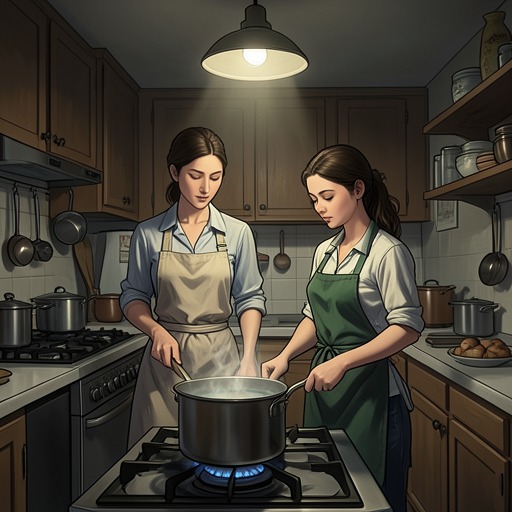
Rosaura
Like Water for ChocolateRosaura is Tita’s older sister, Pedro Muzquiz’s wife, and the mother of Roberto and Esperanza. Her life is shaped by marriage and motherhood, but also by the family rule that assigns the youngest daughter to care for her mother. That rule first prevents Tita from choosing a husband; later, Rosaura invokes it to claim Esperanza’s future. Her place in the family thus links the tradition’s original force to the struggle that eventually breaks its hold on the next generation.
Identity and Background
Rosaura is two years older than Tita. When Pedro asks to marry Tita, Mama Elena refuses because her youngest daughter is expected to remain at home and care for her mother. Instead, Mama Elena presents Rosaura as an available bride. The proposal makes Rosaura’s marriage part of the arrangement that blocks Tita’s relationship with Pedro, even though the available evidence does not present Rosaura as the author of that decision.
Rosaura and Tita’s relationship is strained by the marriage. Rosaura later admits that jealousy had kept her from speaking openly with her sister: she suspected that Tita and Pedro were in love despite the appearance of an ordinary family. The sisters’ conflict is not simply a contest over Pedro. It is also a conflict over what a family owes its daughters, and over who has the authority to decide how those daughters will live.
Marriage and Motherhood
Rosaura and Pedro have two children. Their first, Roberto, is celebrated at his baptism with a grand meal; Tita prepares the mole and has earthenware dishes made bearing the baby’s name. Tita feels unexpected tenderness toward her nephew, despite his being the child of her sister’s marriage to the man she loves. This early family gathering therefore places affection and rivalry side by side: Roberto belongs to Rosaura and Pedro, but Tita becomes deeply attached to him.
After Mama Elena’s death, Rosaura gives birth to Esperanza prematurely. Complications during delivery require John Brown to perform an operation that leaves Rosaura unable to become pregnant again. Pedro proposes that the baby be named Josefita after Tita, but Tita objects, fearing that her name might shape the child’s fate; at Tita’s request, the girl is named Esperanza. Since she is Rosaura’s only child and a daughter, the family tradition would designate her to care for her mother for life.
Rosaura cannot nurse Esperanza. Tita, who had nursed Roberto, does not take on that role this time, in part because she has learned how painful it can be to form an intense bond with a child who is then taken from her. Instead, she feeds Esperanza the gruels and teas Nacha had used for Tita as an infant. The different arrangement marks a change in Tita’s own boundaries, even as Rosaura’s dependence on her daughter begins to take shape.
Authority, Conflict, and Care
Rosaura eventually speaks to Tita about the deterioration of her marriage. She believes her weight, digestive problems, and bad breath are contributing to Pedro’s growing distance, and she describes his avoidance as a rejection. She recalls that the change began after the night Mama Elena’s ghost appeared: Pedro paid little attention to her account, did not respond when she tried to embrace him, and later wept quietly. Rosaura asks Tita for help, acknowledging that jealousy had kept her from seeking her sister’s advice before. Tita responds by offering to prepare a special diet and a remedy for the bad breath.
This moment of openness does not resolve their deeper disagreement. Rosaura considers Esperanza’s lifelong care of her a settled obligation. When Alex, John Brown’s son, expresses a childish wish to marry the baby, Rosaura explains that Esperanza is destined to remain with her. Tita is appalled that her sister intends to pass on the very rule that has denied Tita a life of her own choosing.
The argument becomes explicit when Rosaura confronts Tita. Tita says that she and Rosaura have long needed to discuss the fact that Rosaura married Tita’s boyfriend. Rosaura rejects Tita’s claim to Pedro and, as Esperanza cries, says she will feed her daughter herself and no longer allow Tita to do so. She portrays Tita as a corrupting influence and threatens to keep her away from Esperanza. Tita, in turn, tells her she will not allow the child’s life to be ruined by the family tradition. Their dispute over the past has become a direct struggle over the girl’s future.
The Pact and Esperanza’s Future
For about twenty years, Tita and Pedro keep their relationship secret under an agreement with Rosaura. The arrangement is designed to preserve the appearance that Rosaura’s marriage is intact and to let Esperanza grow up within a family structure Rosaura regards as essential to her moral formation. Tita and Pedro agree to discretion and to having no child together. In return, Rosaura agrees to share Esperanza with Tita: Tita will feed the girl, while Rosaura directs her education. Rosaura is also expected to live with them amicably and without jealousy or complaint. The agreement makes caregiving a negotiated role, but it does not give Tita equal influence over Esperanza’s upbringing.
Rosaura resists sending Esperanza to school, arguing that a girl destined to care for her mother needs no further education. She favors lessons in piano, singing, and dancing, which she believes will entertain her and help Esperanza shine at social gatherings. After three lengthy conversations, Pedro and Tita persuade Rosaura to send the girl to the best school in Piedras Negras. They partly win her agreement by emphasizing the social advantages of an education. Tita supplements the school’s lessons with knowledge about love and life learned through the kitchen, offering Esperanza a different inheritance from the one Rosaura intends.
When Alex and Esperanza later meet again and become attracted to each other, Rosaura opposes their courtship. She argues that Pedro and Tita have violated the pact and asserts her right to keep her daughter at home. The dispute develops into three days of intense conflict within the household. Rosaura dies amid the worsening struggle, with her longstanding digestive illness identified as the cause, though the narration does not specify the precise medical cause of death. Her death ends her claim to Esperanza’s future. Tita’s greatest triumph is helping bring about Esperanza and Alex’s wedding, which Rosaura had fought to prevent.
Narrative Role and Significance
Rosaura is both constrained by family arrangements and an agent of their continuation. Mama Elena’s choice of her as Pedro’s bride helps separate Tita from the man she loves; later, Rosaura tries to make her own daughter accept a lifetime of service. Her insistence is not presented in isolation from her vulnerability: she fears Pedro’s rejection, worries about what others will say, and sees Esperanza as her consolation. Yet those needs lead her to reproduce the rule rather than question it.
The conflict over Esperanza gives the family tradition a generational consequence. Tita’s questions about who designed the rule and whose interests it serves find a later, practical answer in the sisters’ struggle: education and marriage offer Esperanza alternatives to lifelong dependence, while Rosaura’s claim treats care as a daughter’s predetermined duty. The pact briefly makes the arrangement negotiable, but the dispute over schooling and Alex exposes its limits. Rosaura’s death and Esperanza’s marriage mark the end of her authority over that future, while Tita’s role in the wedding signals the possibility of a different inheritance.